
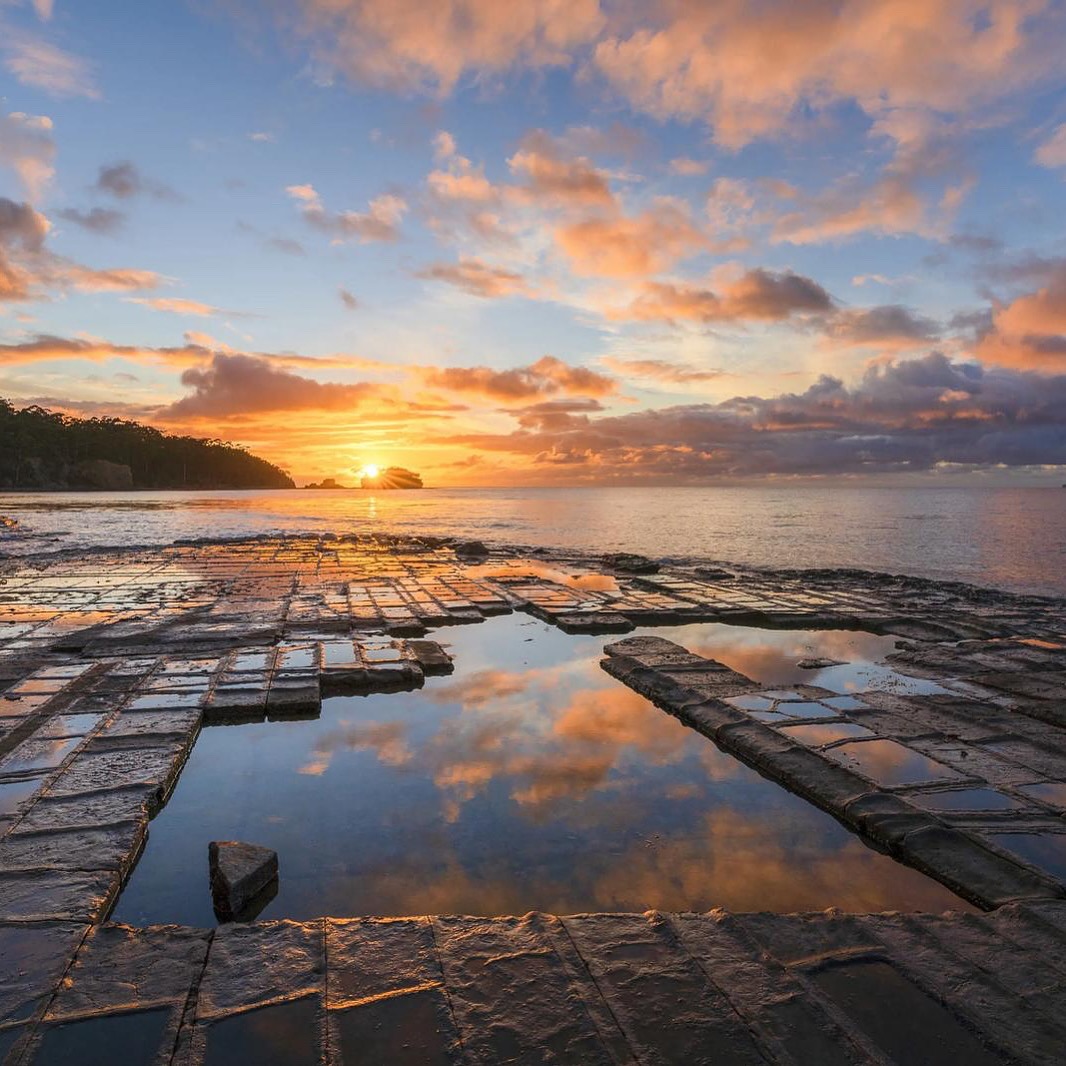
Eaglehawk Neck is where the Tasman Peninsula narrows to an isthmus and the coastline begins to feel geological. Within a few minutes of one another are a rock platform divided into near-rectangular blocks, a blowhole cut into the shore, a huge natural arch and a deep coastal chasm.
The stops are easy to reach individually, but they make more sense together. The same sedimentary coast is being fractured, undercut and opened by the Tasman Sea in different ways, while the optional Waterfall Bay walk lets you leave the car and follow the cliff line for longer.
How to get there
From Hobart, follow the Tasman Highway through Sorell, then continue on the Arthur Highway through Dunalley to Eaglehawk Neck. Allow about an hour and a half before stops.
For Tessellated Pavement, turn onto Pirates Bay Drive and use the signed car park above the shore. The pavement is reached on a short walk down to the rock platform. Tasman Arch, Devils Kitchen and the Blowhole sit in the same broader Eaglehawk Neck coastal circuit and are normally linked by short drives and formed visitor paths.
A valid Tasmania national parks pass is required for the Tasman National Park sites. The formations are close together, so it is better to park at each signed visitor area and walk the established paths than to improvise roadside access.
What to see and do
Tessellated Pavement
The pavement is the best place to start because the geology is visible at your feet. Natural joint lines divide the flat sedimentary rock into a grid that can look almost constructed, while wave action and salt weathering have exaggerated the pattern over time.
Look for the two different surface forms rather than only the overall grid. Lower, wetter sections develop shallow “pan” depressions, while higher sections can weather into raised “loaf” shapes. Near low tide, more of the platform is exposed and water collected in the joints and pans makes the pattern easier to read.
The rock can be slippery when wet and the platform is still an exposed shoreline. Keep a sensible distance from incoming waves rather than walking further out simply for the photograph.
The Blowhole
The Blowhole is a former sea cave where erosion has opened the roof behind the cliff edge. Water is forced through the remaining channel, although the effect varies dramatically with swell and tide. In calm weather the geology is still clear even when the “blow” itself is subdued.
This is one of the reasons to see the sites as a group: the Blowhole shows an intermediate stage between an enclosed cave and the larger openings visible nearby.
Tasman Arch and Devils Kitchen
Tasman Arch is the most monumental of the easy-access formations, with the sea visible through a huge opening cut into the layered coastal rock. A few minutes away, Devils Kitchen is a deep, narrow chasm where erosion has progressed further and the roof has disappeared.
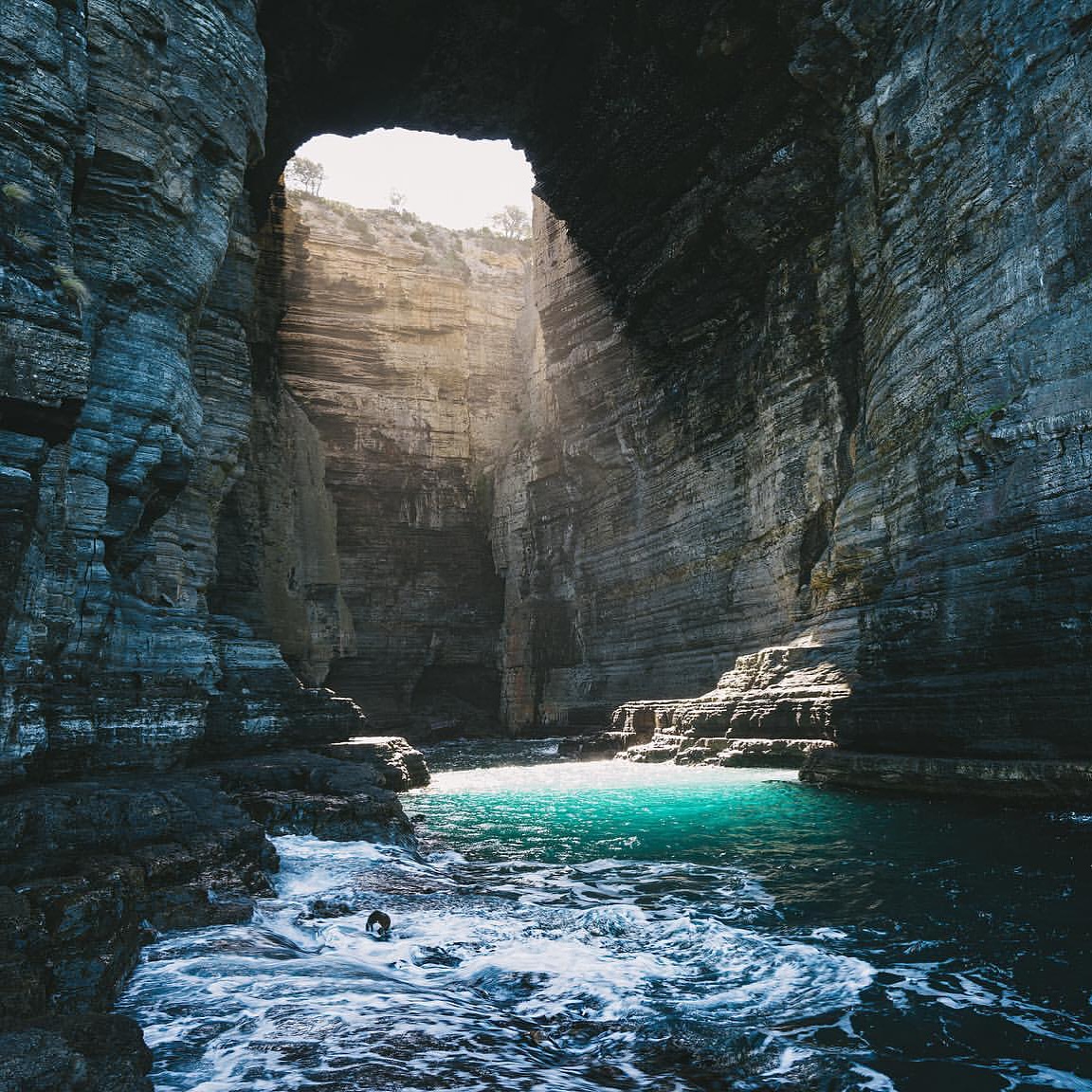
As of 4 October 2026, Tasman Arch and Devils Kitchen are temporarily closed while Parks and Wildlife Service completes access and viewing upgrades. The current closure is scheduled to run until 17 October 2026. Check the live parks alert before travelling specifically for these two sites.
Waterfall Bay
If you want to turn the circuit into more than a series of roadside stops, Waterfall Bay is the natural extension. The coastal walking country continues above high cliffs and sea-cut arches and gulches, ending at a lookout towards a waterfall that drops over the cliff after sufficient rain.
Normally the coastal track can be approached from the Tasman Arch and Devils Kitchen area. During the current construction closure, that access is closed and Parks and Wildlife Service directs visitors to enter from Waterfall Bay Road instead.
Eaglehawk Neck Historic Site
The narrow neck itself also explains why this place mattered long before the modern scenic stops. The 1832 Officers’ Quarters formed part of the military barrier designed to stop convicts escaping the Tasman Peninsula, reinforced by the notorious line of tethered dogs across the isthmus.
The Officers’ Quarters sit outside the national park and do not require a parks pass. It is a useful short historical counterpoint if you have time after the coast.
How much time to allow
Allow around half a day for Tessellated Pavement, the Blowhole and the Tasman Arch / Devils Kitchen precinct when all sites are open. The driving distances are short, but each stop is better when you leave enough time to walk the platforms and look at how the geology changes from one formation to the next.
Add more time if you walk at Waterfall Bay or visit the Officers’ Quarters. If you are coming from Hobart, the cluster works well as the northern half of a Tasman Peninsula day, but do not try to combine it with a substantial Cape walk and Port Arthur Historic Site unless you are prepared to rush all three.
Practical notes
- A valid Tasmania national parks pass is required for the Tasman National Park visitor sites.
- Visit Tessellated Pavement near low tide if possible. Wet rock is slippery and waves can wash across the platform.
- Tasman Arch and Devils Kitchen are currently closed until 17 October 2026 for visitor-access works. Check the Parks and Wildlife Service alert before travelling.
- During the closure, the Waterfall Bay track cannot be entered from Devils Kitchen; access remains available from Waterfall Bay Road.
- The Officers’ Quarters at Eaglehawk Neck Historic Site are outside the national park and do not require a parks pass.
- Coastal wind and swell can change quickly. Stay behind barriers and use formed viewing paths around cliffs and chasms.
A suggested plan
Start at Tessellated Pavement around low tide, then continue through Eaglehawk Neck to the Blowhole and, once reopened, Tasman Arch and Devils Kitchen. Add Waterfall Bay if you want a longer coastal walk, and finish at the Officers’ Quarters if the convict history of the isthmus interests you.