
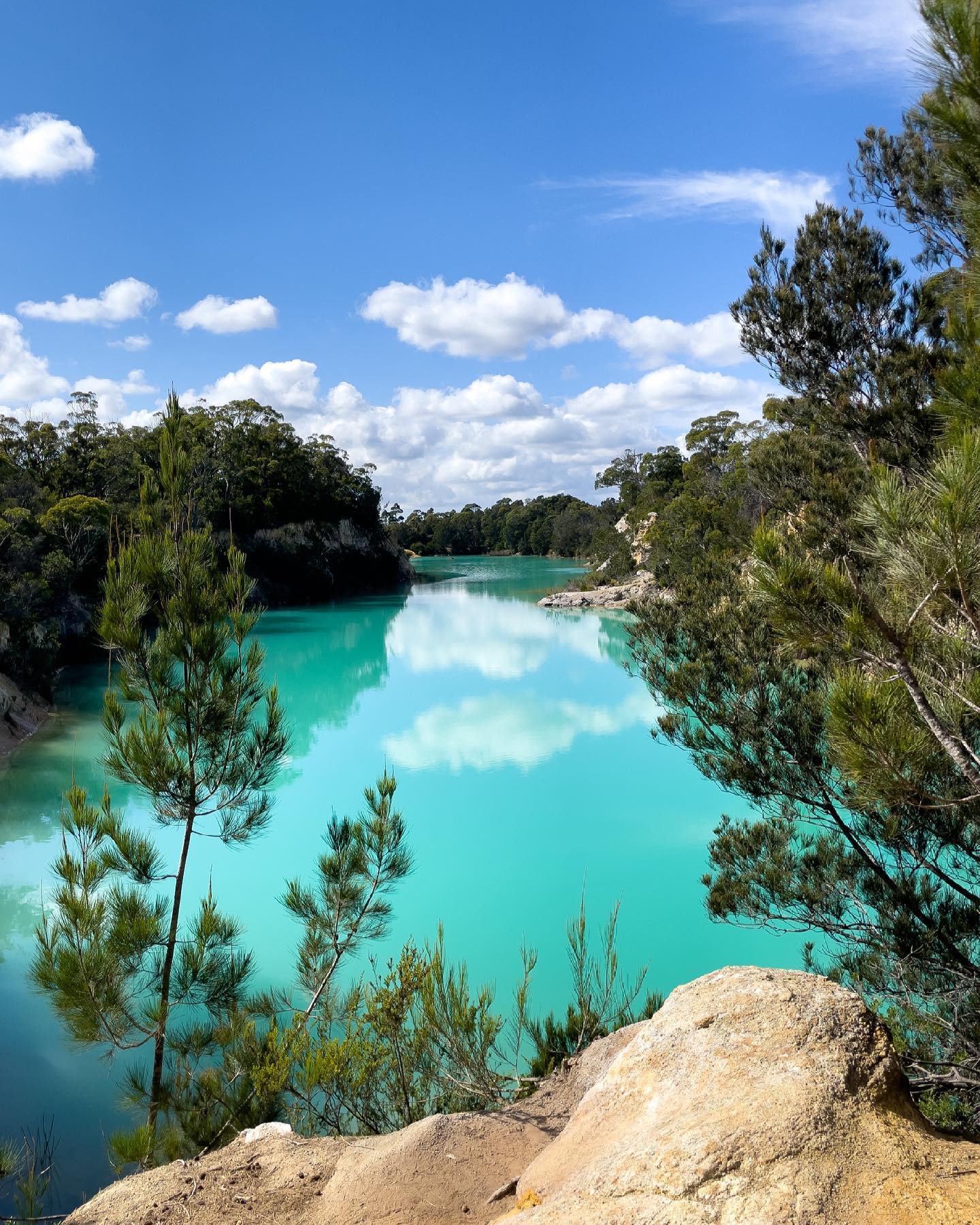
Little Blue Lake is one of north-east Tasmania's easiest detours. The vivid turquoise water fills a former mining hole at South Mount Cameron, where minerals exposed during the district's tin-mining era remain responsible for the colour seen today.
The lake is striking, but this is a place to look rather than swim. Official visitor information advises against swimming because of the water's high mineral content.
How to get there
Little Blue Lake is at 1753 Gladstone Road, South Mount Cameron, just metres off the B82 between Derby and Gladstone. From Derby, allow about 25 minutes by road. From Gladstone, the lake is around eight minutes away.
If you are travelling from Launceston, allow roughly two hours and make the lake part of a broader north-east trip rather than treating it as a standalone day destination. The final approach is simple: leave Gladstone Road on the short access road into the parking area, with the lake immediately beyond.
What to see
The turquoise water
The colour is the reason to stop. Minerals exposed during the area's mining history give the water its vivid aqua appearance, framed by pale banks and surrounding eucalypts. It is especially unusual because the lake is not a remote alpine tarn or coastal lagoon, but a former mine hole sitting only metres from the road.
There is no formal long walk required to see it. Give yourself time to move around the main viewing area, look across the lake from different angles and photograph the contrast between the blue water and the bush.
The mining landscape
Little Blue Lake is part of a broader north-east landscape shaped by tin mining. The lake itself is a direct remnant of those workings, and nearby Derby tells the same story on a much larger scale, with its former mining infrastructure now sitting alongside one of Tasmania's best-known mountain-bike destinations.
That history matters because it explains both the colour and the swimming advice. The water may look inviting, but the same mineral content that creates the blue is why swimming is not recommended.
Cameron Regional Reserve
If you want more than a roadside stop, there are longer walks elsewhere in Cameron Regional Reserve. Dorset Council lists the 5 km Cube Rock Walk and the 5.1 km Whale Rock walk, with around two hours suggested for each.
Treat those as separate bushwalking objectives rather than an extension of a lap around the lake. Little Blue Lake itself works best as the quick, visually distinctive stop; the reserve gives you an option to turn the area into a longer visit.
Pair it with Derby or Gladstone
Little Blue Lake fits naturally into a north-east road trip. Derby is about 25 minutes south and is the obvious place to combine it with food, coffee, mountain biking or more mining history. Gladstone is much closer to the north and has public toilets, a barbecue, covered picnic area and playground at Gladstone Park.
Timing
Allow around 20 to 40 minutes for Little Blue Lake itself. That is enough time to get out of the car, look around the main viewing area and take photographs; the lake itself does not require a half-day visit.
Stay longer if you are stopping for a picnic, or add roughly two hours if you choose one of the Cameron Regional Reserve walks. If you are coming from Launceston, the stronger plan is to combine the lake with Derby and other north-east stops rather than drive out and back for the lake alone.